



Halévy's La TempestaWexford Festival, October/November 2022 Charles Jernigan, November 2022 Photographs by Clive Barda, courtesy of Wexford Festival. La tempesta, which opened the festival, has an interesting if brief history. In the 1840s Her Majesty's Theater, long the venue for Italian opera in London, was failing: many of the principal singers had left to form a new company which became Covent Garden, and audiences at Her Majesty's were falling off. The impresario, Benjamin Lumley, wanted to produce a new opera which would cause a stir and bring back the audience: he needed a 'hit'. His plan was to use a subject dear to the hearts of Englishmen by basing the new work on a play by England's greatest playwright, William Shakespeare. It would have to be in Italian, the language of most operas performed in London since the time of Handel. Lumley wanted a major librettist and composer too, and he planned to hire some of the greatest star singers of the day. The librettist he preferred was Felice Romani (author of Norma, La sonnambula, Anna Bolena and many other works in the 1820s and 30s), and the composer he wanted was Felix Mendelssohn. Mendelssohn, however, preferred Eugène Scribe, the greatest French librettist of the period, so Lumley engaged Scribe to write the libretto, which was translated from French to Italian by Pietro Giannone. Mendelssohn was unimpressed—and angry that Lumley had publicized him as the composer before anyone had signed a contract, and in any case he died unexpectedly in November, 1847, before work could begin. Lumley then turned to Halévy, already famous for La Juive (1835) and many other grand operas and opéra-comiques, several of which had been heard in London, and Halévy agreed to set Scribe's libretto. As for star singers, Lumley had his sights set on Jenny Lind for Miranda, then at the height of her popularity in England, and Luigi Lablache for Calibano. In the event, Lind retired from the operatic stage at age 29 in 1849. Lumley turned to Henriette Sontag, who had retired from opera in 1829 when she married Count Rossi, and Sontag agreed to sing again because she and her husband needed the money. Filippo Coletti was the Prospero and Michael Balfe conducted. Originally, the role of Ariele, Prospero's magic sprite, was to be a singer, and Halévy composed vocal music for her, but by the time the delayed production reached the stage in 1850, Ariele had become a mute role given to the dancer Carlotta Grisi, arguably the most famous ballerina of the time. Some of Halévy's vocal music went to an "Air Sprite" while new dance music was composed for Grisi. The performance which finally took place on 6 June, 1850, at Her Majesty's Theatre, was a great success and ran for about thirteen performances before Grisi's departure forced the show to close. It was not enough to save Her Majesty's Theatre, however, which closed a couple of year's later. Lumley next took over management of the Théâtre Italien in Paris, and soon introduced La tempesta there. At the first night, a new dancer, Carolina Rosati, playing the role of Ariele, fell through an open trap door in the stage, and although she finished the performance, the frightening accident and the delay it caused overshadowed all other aspects of the performance and the opera failed. After that, until now, La tempesta has been unstaged and unheard. The story in Scribe's libretto follows Shakespeare faithfully at first, but then veers away in the latter part of the work. Prospero, the Duke of Milan, has been overthrown by his brother Antonio with the connivance of Alonso, the King of Naples, who have set Prospero adrift in a boat with his infant daughter Miranda. They have found safety on an island inhabited by Calibano and his mother, the witch Sicorace. Prospero, with his magic, has imprisoned Sicorace in a rock and released the good spirit Ariele from her power, while Calibano has become his slave. The opera opens with a Prologue which depicts the " tempest" of the title, a storm engineered by Prospero and Ariele in order to wreck the boat carrying Alonso and Antonio along with Alonso's son Fernando. These men, along with the sailors, are cast ashore on Prospero's island. In Act One, Miranda learns about the situation on the island from her father, and she first sees Fernando and falls in love with him. In Act Two, the unseen voice of Sicorace orders Calibano to collect some magic flowers which will grant him three wishes. She wants her son to use one wish to free her from the rock, but he refuses. Instead, the first wish is used to put Ariele to sleep and imprison her in a tree; the second is used to make Miranda fall into a sleep because Calibano lusts after her and he plans a rape. Carrying her sleeping body, he runs into the sailors from the ship and they get him drunk with rum; he falls asleep. In the third and final act Miranda steals the flowers and uses the last wish to make the sailors sleep; she escapes. Prospero frees Ariele from the tree (replaced by a giant stone head in this production) and sends her to search for Miranda. Miranda encounters the disembodied voice of the rock-imprisoned Sicorace, which tells her to kill Fernando, whom she calls an enemy. Miranda prepares to kill the sleeping Fernando, but he awakes in time and his ardent love convinces her that he is no enemy. Prospero, Ariele and the repentant Antonio and Alonso arrive and all are reconciled for the happy ending. They sail away to Italy, leaving Calibano and Sicorace on the magic island. It is likely that Benjamin Lumley asked Halévy to write his opera in the style of Italian works of the primo ottocento, that is a traditional numbers opera, with cavatinas, cabalettas and ornate, embellished vocal lines à la Rossini, combined with rousing choruses, drinking songs and the like. London audiences (Lumley thought) were more attuned to operas of the 1830s and 40s than more recent 'noisy' works by composers like Verdi, whose I masnadieri had had only lukewarm success in London (with Jenny Lind) in 1847. Thus La tempesta seems like an opera from the 1830s in its formal structure and ornamentation. It did not sound like Verdi, who one year after La tempesta's premiere, would produce the ground-breaking Rigoletto. Musically, Halévy's score is workmanlike and occasionally rises above the generic clichés of its time (or really of Rossini, Donizetti and Bellini's time) to find dramatic expression in ensembles and memorable melodies, although the arias tend to be cut from the generic cloth of the age. Miranda' s entrance (" Parmi una voce il murmure") speaks of the natural world which enchants Miranda and has insects caroling; the cabaletta is much embellished. Prospero's Romanza, " Sorge un fiore" fell flat in our performance, as did Fernando's Cavatina " Cara, soave aerea voce," a difficult aria, requiring high notes and much fioratura of the tenor. On the other hand, the whole Prologue depicting the tempest at sea, which was mostly choral, followed by the inevitable prayer was reasonably descriptive of the storm and the foundering of the ship carrying Alonso, Antonio and Fernando. A nice duet for Fernando and Miranda, which becomes a trio with the addition of Prospero, ends Act 1.
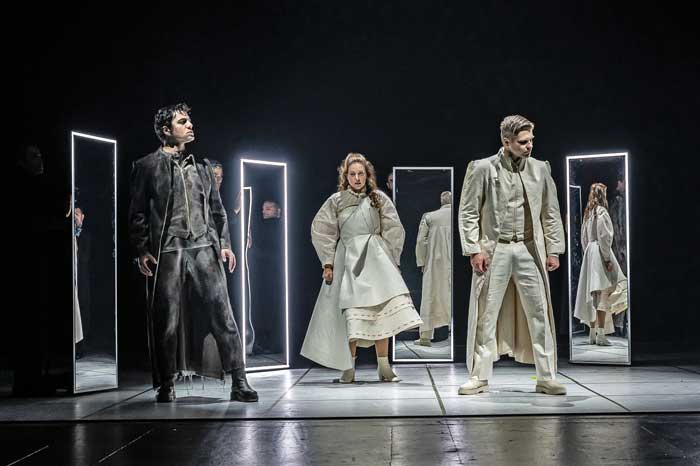
WFO © CLIVE-BARDA/ArenaPAL Caliban, Miranda and Prospero in the Act 1 trio Act 2, which centers on Caliban's finding of the magic flowers and his attempted rape of Miranda through the drunken finale, contains the best music in the opera, and is especially good beginning with a rollicking drinking song " Ci oppresse abbastanza de' mali il pensier" through the scene as Calibano succumbs to rum. There is a graceful trio in the last act, and Miranda gets a highly ornamented rondo finale (" Vinto, la nature e amor"), just as if this were an opera by Rossini or early Donizetti. Unfortunately, the Wexford production (a co-production with the Teatro Coccia, Novara) completely failed to animate the Festival theme of "Magic & Music". The production by Roberto Catalano (stage director), Emanuele Sinisi (set designer), Ilaria Ariemme (costumes) and D. M. Wood (lighting) had no magic and often militated against any feeling of magic which the score might possess. A stilt walker in costume welcoming patrons to the theatre and a lady dressed as a sorceress flitting among patrons in the lobby were about as close as the evening got to magic . The problem lay with both the singing and the production. Soprano Hila Baggio (Miranda) and tenor Giulio Pelligra (Fernando) were simply not up to the coloratura requirements of their roles; Pelligra in particular is of the " can belto" school of singing which might work for verismo, but is so inappropriate for this kind of opera. Young Jade Phoenix made a positive impression as Ariele, although her wig and costume were more aging dowager than air sprite, and Georgian bass Nikolay Zemlianskikh elicited dead silence for his two arias. Best of all the cast was Georgian bass Giorgi Monoshvili as Calibano. The production only took off, both vocally and theatrically, in scenes where he was the featured singer. (Nineteenth century critics found Luigi Lalblache's portrayal of Calibano as the best feature of the first performances too.) Rory Musgrave, Richard Shaffrey, Gianluca Moro and Dan D'Souza were fine as Alonso, Antonio, Stefano and Trinculo, and Emma Jüngling sang the unseen Sicorace, her voice emerging from two beat-up loud speakers dropped from above on a metal pipe. Sicorace seemed to be imprisoned in the audio system for a high school football match; there was no rock in sight. Francesco Cilluffo, who has done excellent work with verismo operas, conducted as if this were another veristic work; on opening night the Festival Orchestra was loud, without much subtlety or shading, but they improved at the second performance (24 October).
WFO © CLIVE-BARDA/ArenaPAL Calibano carries the sleeping Miranda Wexford reverted to the autograph score which called for a singer as Ariele instead of the dancer used in the revised version seen by 1850 audiences which had been entranced by the "magic" of Grisi's dancing. Nonetheless six "dancers" were listed in the program and Luisa Baldinetti was credited as "Choreographer". There was no choreography, however, and no dancing. Instead the six mute characters, clad in long black overcoats and black turtlenecks, moved about the stage performing ridiculous tasks, carting lights or buckets of water, wiping the stage with cloths and sometimes striking nonsensical poses. It was neither dancing nor "magic". The six were described as 'sprites who protect Miranda', but they were very dour sprites. The production was abstract and seemed to be deliberately anti-magical. In a program note Catalano, the Director, tried to explain his vapid and cliched ideas. It is always a problem when a stage director has to explain his ideas. In his explanation, Prospero's island was a "Site of Nostalgia"—and indeed "Nostalgia" was cut into the rock above Prospero's cave, which contained a "wounded past" where "all of the pain we suffered, all the struggles to desperately try to repair the irreparable, comes down to the rediscovery of our tender fragility"— and other pretentious nonsense. Shakespeare's Tempest may be a deep philosophical musing on the playwright's career and the fate of man, but the Scribe/Halévy opera was meant to be an entertainment, a hit to save a dying opera house. In spite of the psycho-babble, Catalano's production often relied on the old-fashioned 'plant your feet and sing to the audience' style in which the singers scarcely acknowledge each other on stage. The exception to this monochromatic format happened when Calibano became the center of interest in Act Two. There, Mr. Manoshvili actually pretended he was involved in the opera, and its story, both vocally and histrionically, took off. The chorus of sailors acted and sang lustily with him too, but it was not enough to save the evening. The monochromatic set and the costumes, faux-Elizabethan, were in shades of grey with white for Ariele, Prospero and Miranda and black for the "sprites". It was another cliché of contemporary design. The "set" was an ugly back wall, sometimes fronted by Prospero's white cave. Ariele wore a white wig; Miranda wore a prom dress gone wrong. There was no magic in the spectacle either. The tempest of the title, ably depicted by Halévy in the Prologue, was non existent on stage. Instead, the dour chorus, clad in black, walked in and stood by a series of hospital beds covered by black plastic tarps (body bags?). Ariele was imprisoned in a huge classical head sculpture, initially covered by scaffolding and plastic tarps. A grey-ish concrete mixer stood nearby. Magic was as far away as it is in a highway construction site. For the trip back to Italy at the end, the " dancers" brought in buckets of water which they poured slowly onto a trough on a 'bed'; Prospero constructed a 'boat" out of a piece of white paper and set it on the "ocean". Original audiences thrilled to the spectacle of the staging at Her Majesty's Theatre; modern audiences had to make do with cheap symbolism. I am indebted to a PhD dissertation by Christopher Hendley which covers every aspect of this opera, and which can be found in its entirety on line here: https://getd.libs.uga.edu/pdfs/hendley_christopher_d_200505_phd.pdf. I agree with Hendley that La tempesta is an opera of historical interest and some musical value. Halévy certainly tried to invest the score with "magic" and sometimes he succeeded. Perhaps an opera goer in Wexford would be wise to follow the Joyce quotation on the program cover to "shut your eyes" and just listen. Even then the magic would be elusive.
WFO © CLIVE-BARDA/ArenaPAL The Happy Ending |